> For the complete documentation index, see [llms.txt](https://docs.luciq.ai/llms.txt). Markdown versions of documentation pages are available by appending `.md` to page URLs; this page is available as [Markdown](https://docs.luciq.ai/organization-settings/user-management/scim-provisioning/advanced-scim-provisioning.md).
# Advanced SCIM Provisioning
Map Luciq roles and app access during SCIM provisioning by creating custom attributes for the Luciq app in Okta, step by step.
{% hint style="info" %}
To map roles and app access during SCIM provisioning, create custom attributes for the Luciq app in Okta.
{% endhint %}
### Update app provisioning
{% stepper %}
{% step %}
### Okta: Open provisioning settings
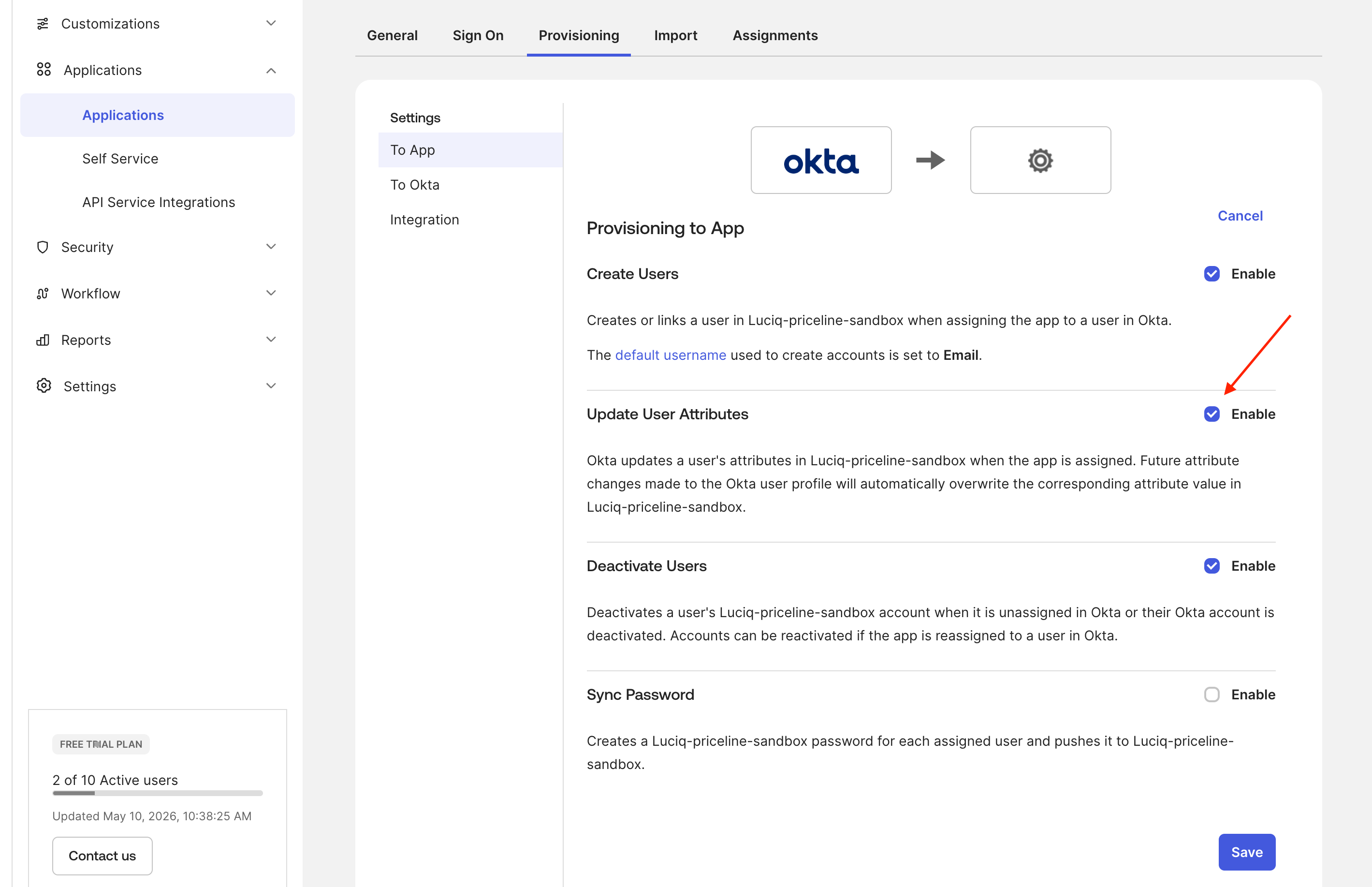
In Okta, go to **Applications → Luciq → Provisioning**.
Click **Edit**.
{% endstep %}
{% step %}
### Okta: Enable attribute updates
In Okta, in **Provisioning**, enable **Update User Attributes**.
{% endstep %}
{% endstepper %}
### Set up Luciq custom attributes
{% stepper %}
{% step %}
### Okta: Open the Luciq user profile
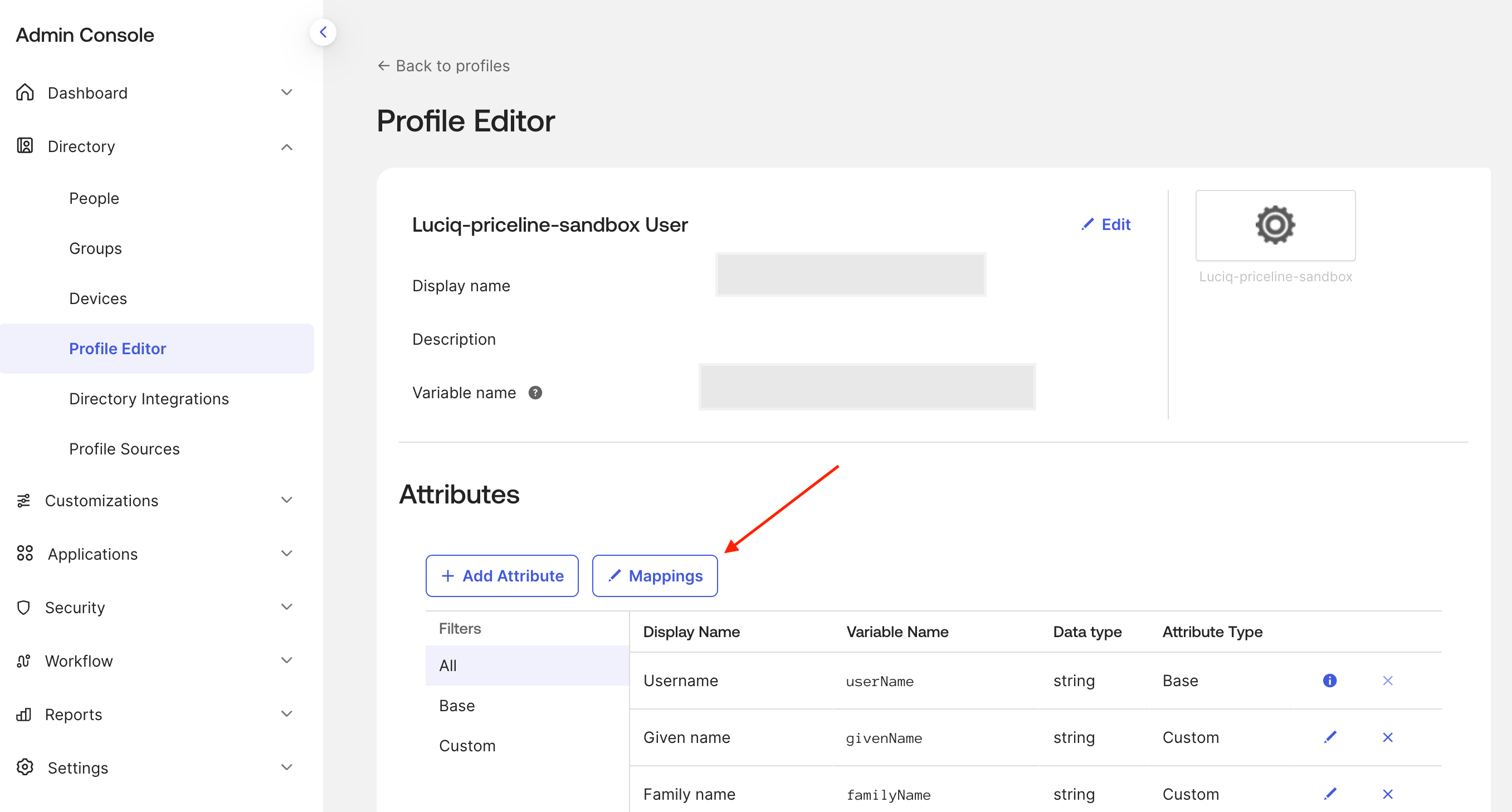
In Okta, go to **Directory → Profile Editor**.
Click **Luciq User**.
{% endstep %}
{% step %}
### Okta: Add a custom attribute
In Okta, in **Luciq User**, click **+Add mappings**.
{% endstep %}
{% step %}
### Okta: Create the role attribute
In Okta, in **Luciq User**, use these values:
1. `Data type` = `string`
2. `Display name` = `Instabug Role`
3. `Variable name` = `instabugRole`
4. `External namespace` = `urn:ietf:params:scim:schemas:extension:instabug:2.0:User`
5. Enable **Enum**.
6. Add the Instabug roles.
7. Choose the **attribute type** based on how you plan to use it:
* **Personal**: Each user is assigned their own value. Choose this if roles vary from user to user.
* **Group**: A single value is shared across a group of users. Choose this if you assign the same role to everyone in a group.
{% hint style="info" %}
For the `Admin` role, use `administrator` as the value.
{% endhint %}
{% endstep %}
{% step %}
### Okta: Create the application access attribute
In Okta, in **Luciq User**, use these values:
1. `Data type` = `string array`
2. `Display name` = `Instabug Applications`
3. `Variable name` = `instabugApplications`
4. `External namespace` = `urn:ietf:params:scim:schemas:extension:instabug:2.0:User`
5. Optional: Enable **Enum**.
6. Optional: Add your Luciq app names. Values must match exactly.
7. Choose the **attribute type** based on how you plan to use it:
* **Personal**: Each user is assigned their own app access. Choose this if app access varies from user to user.
* **Group**: A single set of apps is shared across a group of users. Choose this if you grant the same app access to everyone in a group.
By default, an app name grants access to all of that app's environments. To scope access to a single environment, use the format `App:environment` — for example, `iOS App:Production` grants access to the Production environment only, while `iOS App` grants access to all environments. The environment can be a built-in environment name (`production`, `beta`, `staging`, `alpha`, `qa`, or `development`) or the slug of a custom environment, including slugs that contain hyphens — for example, `iOS App:pre-prod`. Environment names are not case-sensitive, so `iOS App:Production` and `iOS App:production` are equivalent. The environment must be a real environment of that app; otherwise the whole value is treated as an app name. To grant more than one environment of the same app, add a separate value for each (for example, `iOS App:Production` and `iOS App:Beta`).
{% endstep %}
{% endstepper %}
### Configure attribute mapping
If you do not already have matching attributes on **Okta User**, create them first.
{% stepper %}
{% step %}
### Okta: Add an attribute to Okta User
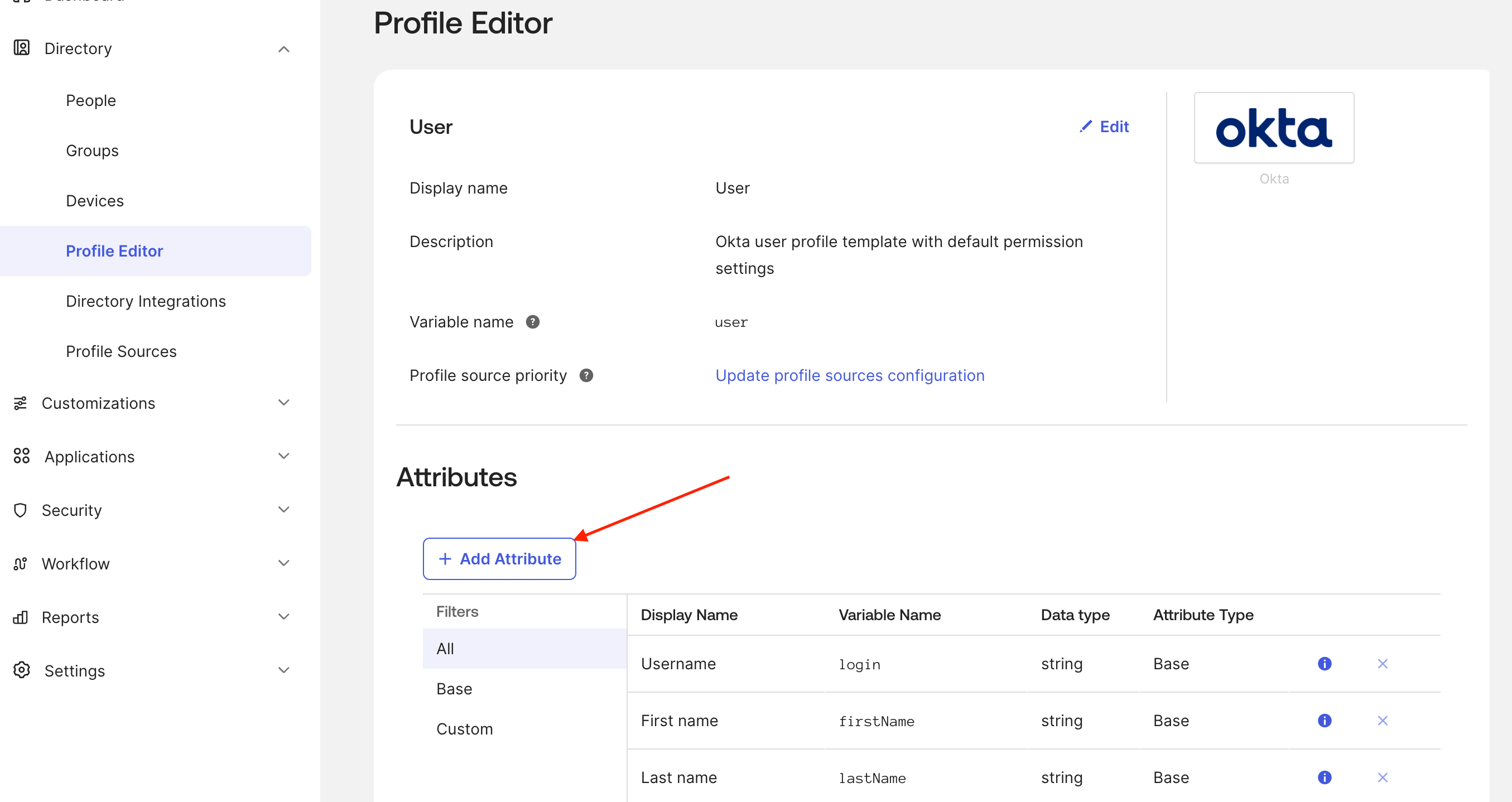
In Okta, go to **Directory → Profile Editor → Okta User**.
Click **Add Attribute**.
{% endstep %}
{% step %}
### Okta: Add Instabug Role
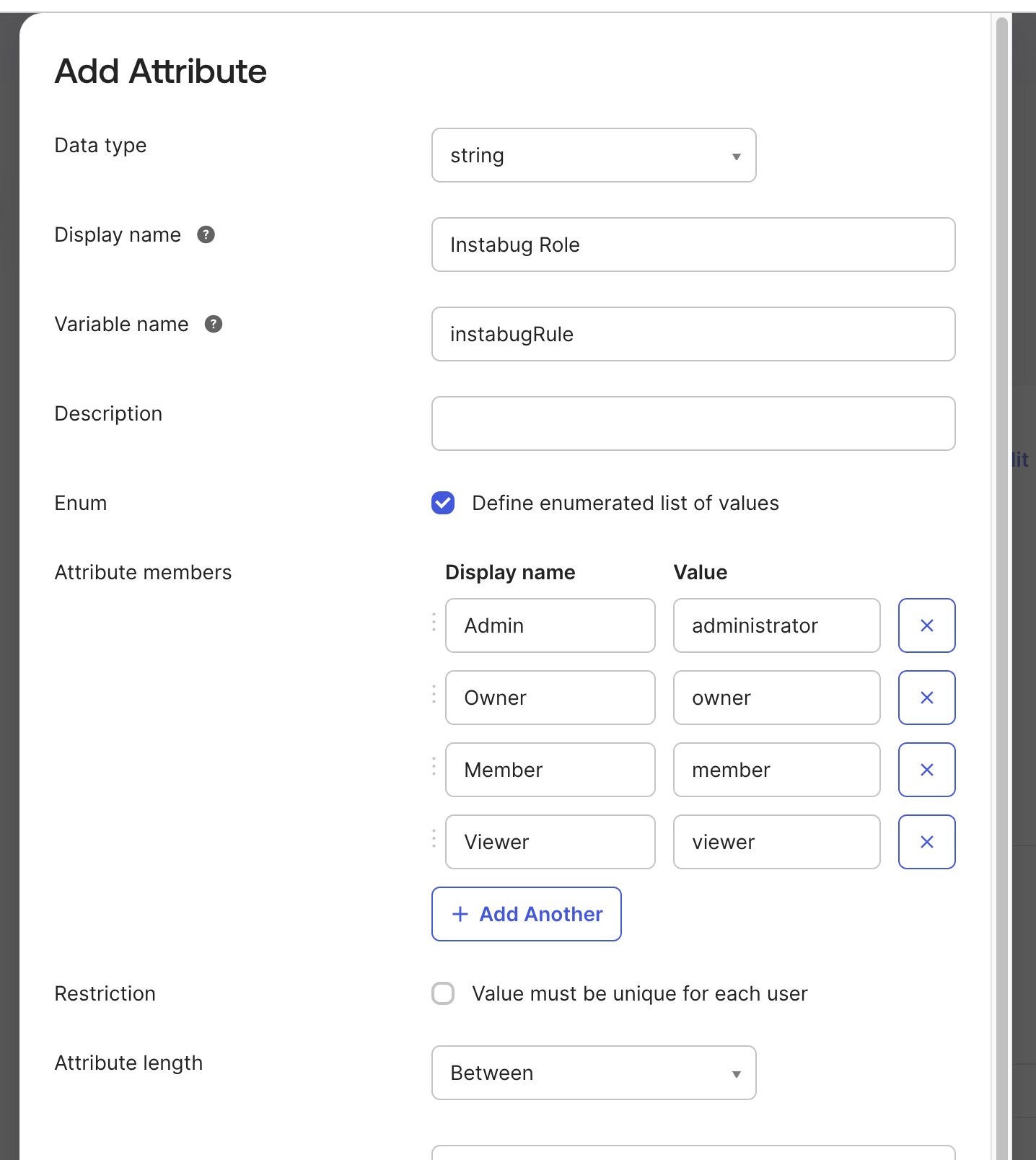
In Okta, in **Okta User**, use these values:
1. `Data type` = `string`
2. `Display name` = `Instabug Role`
3. `Variable name` = `instabugRole`
4. Enable **Enum**.
5. Add the Instabug roles.
{% endstep %}
{% step %}
### Okta: Add Instabug Applications
In Okta, in **Okta User**, use these values:
1. `Data type` = `string array`
2. `Display name` = `Instabug Applications`
3. `Variable name` = `instabugApplications`
4. Enable **Enum**.
5. Add your Luciq app names. Values must match exactly.
{% endstep %}
{% endstepper %}
### Map Okta User to Luciq User
{% stepper %}
{% step %}
### Okta: Open Luciq mappings
In Okta, go to **Applications → Luciq**.
Click **Edit Mappings**.
Choose **Okta User to Luciq**.
{% endstep %}
{% step %}
### Okta: Map the role attribute
In Okta, in **Okta User to Luciq**, select the **Okta User** attribute to map to Luciq.
From the dropdown, choose `InstabugRole`.
Your mapping should look like this.
{% endstep %}
{% step %}
### Okta: Repeat for `InstabugApplications`
Repeat the same mapping for `InstabugApplications`.
{% endstep %}
{% endstepper %}
***
### Assign roles and app access to users
{% stepper %}
{% step %}
### Okta: Start a new assignment
After setup, when you assign a new user for provisioning, Okta prompts you for role and app access.
These attributes are optional.
{% endstep %}
{% step %}
### Okta: Open user assignment
In Okta, go to **Applications → Luciq**.
Click **Assign → Assign to People**.
{% endstep %}
{% step %}
### Okta: Choose role and app access
In Okta, select a user, then click **Assign**.
Choose a role and app access from the dropdowns.
{% endstep %}
{% endstepper %}
---
# Agent Instructions
This documentation is published with GitBook. GitBook is the documentation platform designed so that both humans and AI agents can read, navigate, and reason over technical content effectively. Learn more at gitbook.com.
## Querying This Documentation
If you need additional information that is not directly available in this page, you can query the documentation by asking a question.
Perform an HTTP GET request on the following URL with the `ask` and `goal` query parameters:
```
GET https://docs.luciq.ai/organization-settings/user-management/scim-provisioning/advanced-scim-provisioning.md?ask=&goal=
```
`ask` is the immediate question: it should be specific, self-contained, and written in natural language.
`goal` is what the user is ultimately trying to achieve, the reason they need the answer. Sharing it helps GitBook give you a better, more relevant answer. A goal is most helpful when it describes the outcome the user wants rather than restating the question. For example, with `ask=how do I create an API token`, a goal like `automate deployments from our CI pipeline` lets GitBook tailor the answer to that use case.
The response will contain a direct answer to the question and relevant excerpts and sources from the documentation.
Use this mechanism when the answer is not explicitly present in the current page, you need clarification or additional context, or you want to retrieve related documentation sections.
%20(1).png?alt=media)
%20(1).png?alt=media)
.png?alt=media)

.png?alt=media)
.png?alt=media)
.png?alt=media)