> For the complete documentation index, see [llms.txt](https://docs.luciq.ai/llms.txt). Markdown versions of documentation pages are available by appending `.md` to page URLs; this page is available as [Markdown](https://docs.luciq.ai/ios/setup-luciq-for-ios/custom-settings/user-identification/tags.md).
# Tags
Add custom tags to bug and crash reports from your iOS app, including tagging from an event handler before a report is sent, then filter by them.
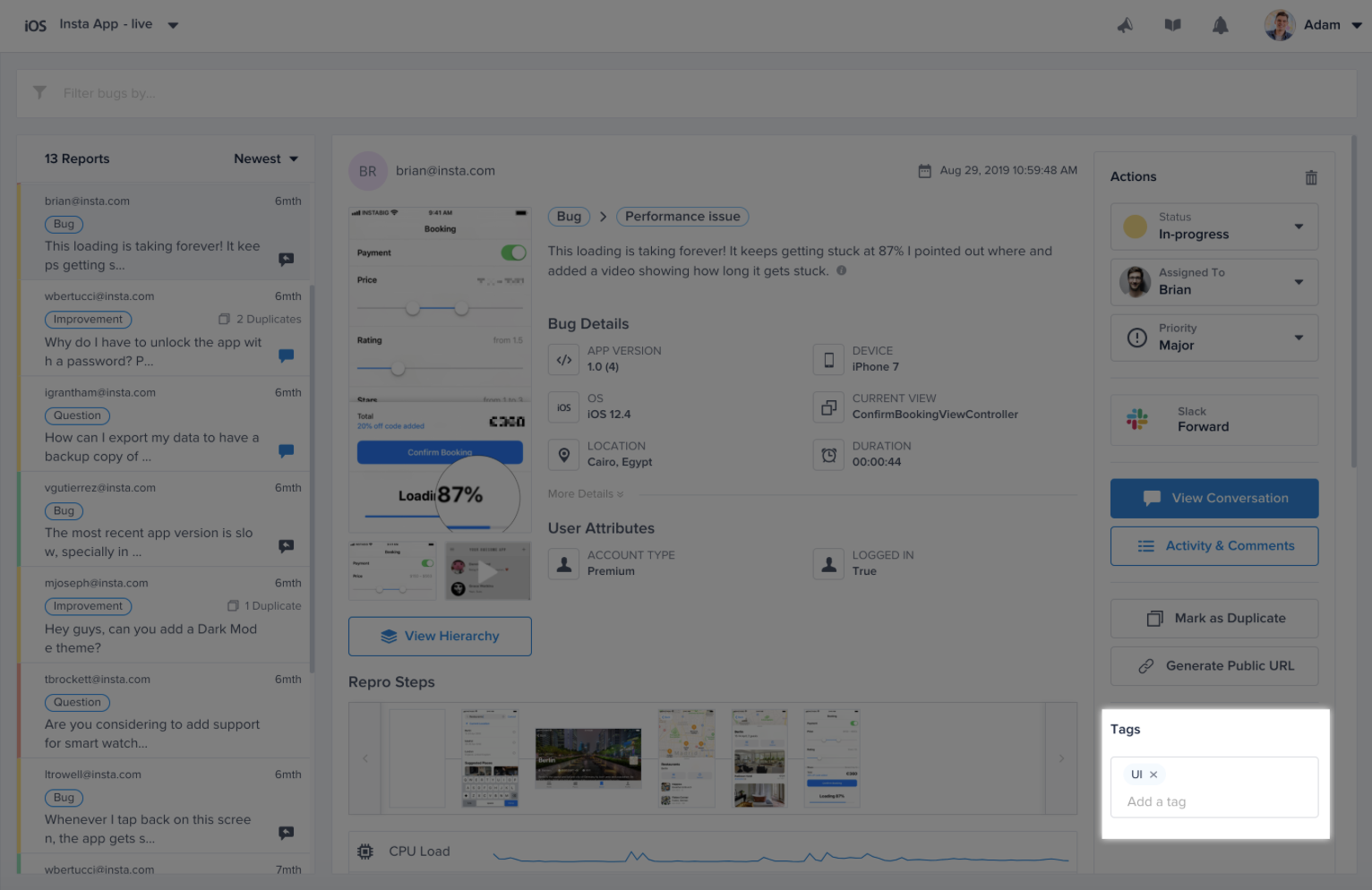
You can add custom tags to your bug and crash reports. These tags can later be used to filter reports or set custom rules from your dashboard.
The example below demonstrates how to add tags to a report.
{% tabs %}
{% tab title="Swift" %}
{% code overflow="wrap" %}
```swift
Luciq.appendTags(["Design", "Flow"])
```
{% endcode %}
{% endtab %}
{% tab title="Objective-C" %}
{% code overflow="wrap" %}
```objectivec
[Luciq appendTags:@[@"Design", @"Flow"]];
```
{% endcode %}
{% endtab %}
{% endtabs %}
{% hint style="info" %}
### Adding tags before sending reports
Sometimes it's useful to be able to add a tag to a bug report before it's been sent. In these cases, the perfect solution would be use the event handlers of the bug reporting class. You can find more details [here](/ios/setup-luciq-for-ios/setup-bug-reporting/bug-reporting-callbacks.md).
{% endhint %}
You can also get all the currently set tags as follows.
{% tabs %}
{% tab title="Swift" %}
{% code overflow="wrap" %}
```swift
let tags = Luciq.getTags()
```
{% endcode %}
{% endtab %}
{% tab title="Objective-C" %}
{% code overflow="wrap" %}
```objectivec
NSString *tags = [Luciq getTags];
```
{% endcode %}
{% endtab %}
{% endtabs %}
Last, you can reset all the tags.
{% tabs %}
{% tab title="Swift" %}
{% code overflow="wrap" %}
```swift
Luciq.resetTags()
```
{% endcode %}
{% endtab %}
{% tab title="Objective-C" %}
{% code overflow="wrap" %}
```objectivec
[Luciq resetTags];
```
{% endcode %}
{% endtab %}
{% endtabs %}
### Managing Tags
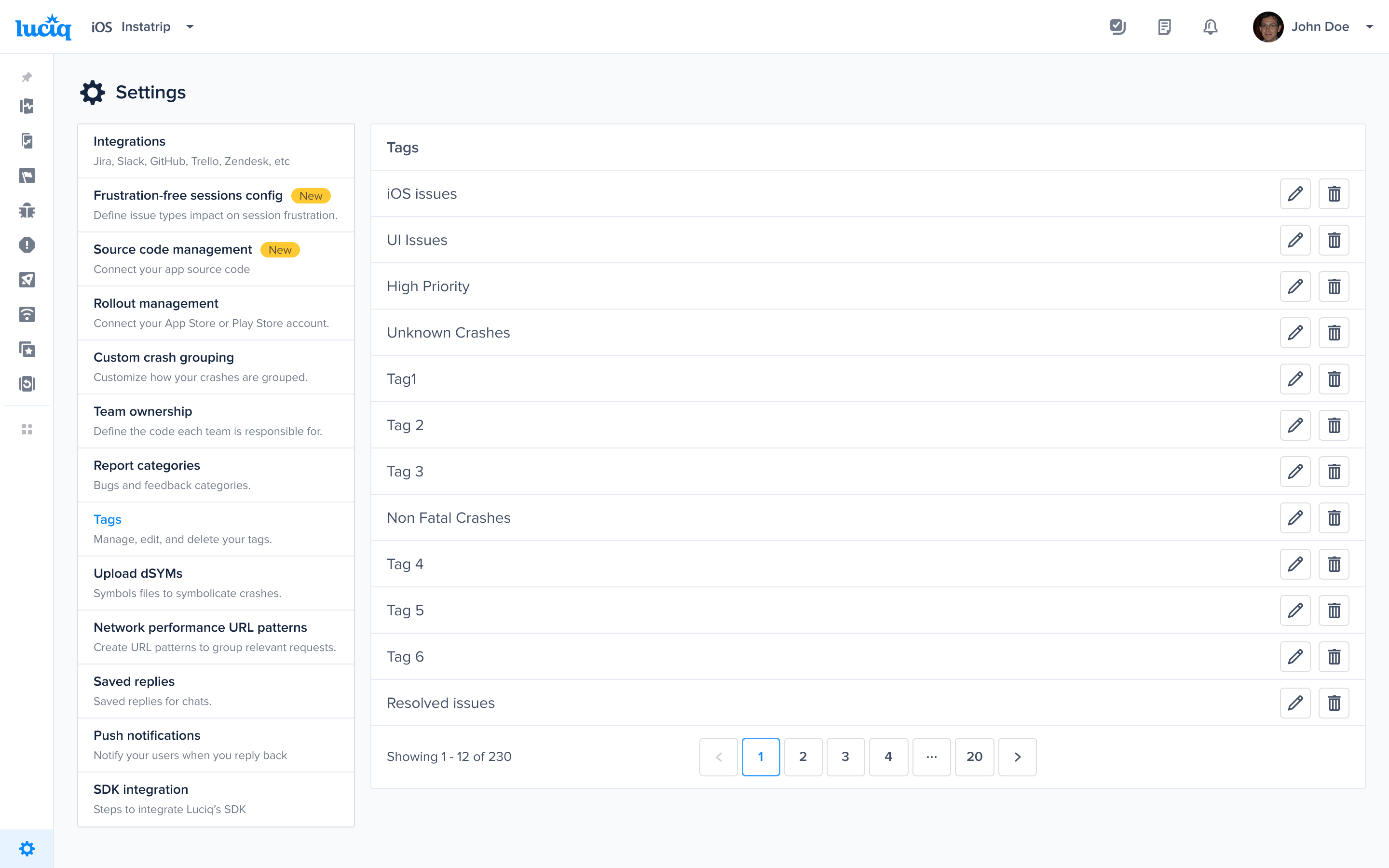
If you'd like to remove a particular tag from your dashboard to prevent it from appearing again when entering a new tag manually, you can do so by navigating to the tags page under the settings options and remove the tag. You can also edit and rename the tag.
---
# Agent Instructions
This documentation is published with GitBook. GitBook is the documentation platform designed so that both humans and AI agents can read, navigate, and reason over technical content effectively. Learn more at gitbook.com.
## Querying This Documentation
If you need additional information that is not directly available in this page, you can query the documentation dynamically by asking a question.
Perform an HTTP GET request on the current page URL with the `ask` query parameter, and the optional `goal` query parameter:
```
GET https://docs.luciq.ai/ios/setup-luciq-for-ios/custom-settings/user-identification/tags.md?ask=&goal=
```
`ask` is the immediate question: it should be specific, self-contained, and written in natural language.
`goal` is optional and describes the broader end goal you are ultimately trying to accomplish on behalf of the user. GitBook uses it to tailor the answer towards what is most useful for that goal.
The response will contain a direct answer to the question and relevant excerpts and sources from the documentation.
Use this mechanism when the answer is not explicitly present in the current page, you need clarification or additional context, or you want to retrieve related documentation sections.