> For the complete documentation index, see [llms.txt](https://docs.luciq.ai/llms.txt). Markdown versions of documentation pages are available by appending `.md` to page URLs; this page is available as [Markdown](https://docs.luciq.ai/ios/setup-luciq-for-ios/custom-settings/sdk-customization/welcome-message.md).

# Welcome Message

This section covers on-boarding your users about how to reach you through Luciq with a mode for either beta testers or live users on iOS apps.

### Setting the welcome message mode

By default, a welcome message that explains how to [show Luciq](/ios/setup-luciq-for-ios/setup-bug-reporting/showing-luciq.md) will be shown to your app users within 10 seconds of starting their first session after the SDK is integrated. The welcome mode can be set to live, beta, or disabled using the method below. The default welcome mode is set to live.

The popups that appear follow the [color theme](/ios/setup-luciq-for-ios/custom-settings/sdk-customization/ui-color-and-theme.md) and [primary color](/ios/setup-luciq-for-ios/custom-settings/sdk-customization/ui-color-and-theme.md) that you set for the SDK.

You can also edit the content of the message using the method and keys found in the [Locale](/ios/setup-luciq-for-ios/custom-settings/sdk-customization/sdk-locale.md) page.

{% tabs %}
{% tab title="Swift" %}
{% code overflow="wrap" %}

```swift
Luciq.welcomeMessageMode = WelcomeMessageMode.beta // For beta testers
Luciq.welcomeMessageMode = WelcomeMessageMode.live // For live users
Luciq.welcomeMessageMode = WelcomeMessageMode.disabled // Disable welcome message
```

{% endcode %}
{% endtab %}

{% tab title="Objective-C" %}
{% code overflow="wrap" %}

```objectivec
[Luciq setWelcomeMessageMode:LCQWelcomeMessageModeBeta]; // For beta testers
[Luciq setWelcomeMessageMode:LCQWelcomeMessageModeLive]; // For live users
[Luciq setWelcomeMessageMode:LCQWelcomeMessageModeDisabled]; // Disable welcome message
```

{% endcode %}
{% endtab %}
{% endtabs %}

### Showing the welcome message manually

Instead of showing the welcome message automatically, you can manually show the welcome message in either live or beta mode using the following method.

{% tabs %}
{% tab title="Swift" %}
{% code overflow="wrap" %}

```swift
Luciq.showWelcomeMessage(with: WelcomeMessageMode.beta) // For beta testers
Luciq.showWelcomeMessage(with: WelcomeMessageMode.live) // For live users
```

{% endcode %}
{% endtab %}

{% tab title="Objective-C" %}
{% code overflow="wrap" %}

```objectivec
[Luciq showWelcomeMessageWithMode:LCQWelcomeMessageModeBeta]; // For beta testers
[Luciq showWelcomeMessageWithMode:LCQWelcomeMessageModeLive]; // For live users
```

{% endcode %}
{% endtab %}
{% endtabs %}

{% hint style="info" %}

### Invocation Method Set to None?

If your [invocation method](/ios/setup-luciq-for-ios/setup-bug-reporting/showing-luciq.md) is set to "none", the welcome message will not appear to your users.
{% endhint %}

### Live welcome message

This mode is primarily aimed at users of your production builds, or live apps.

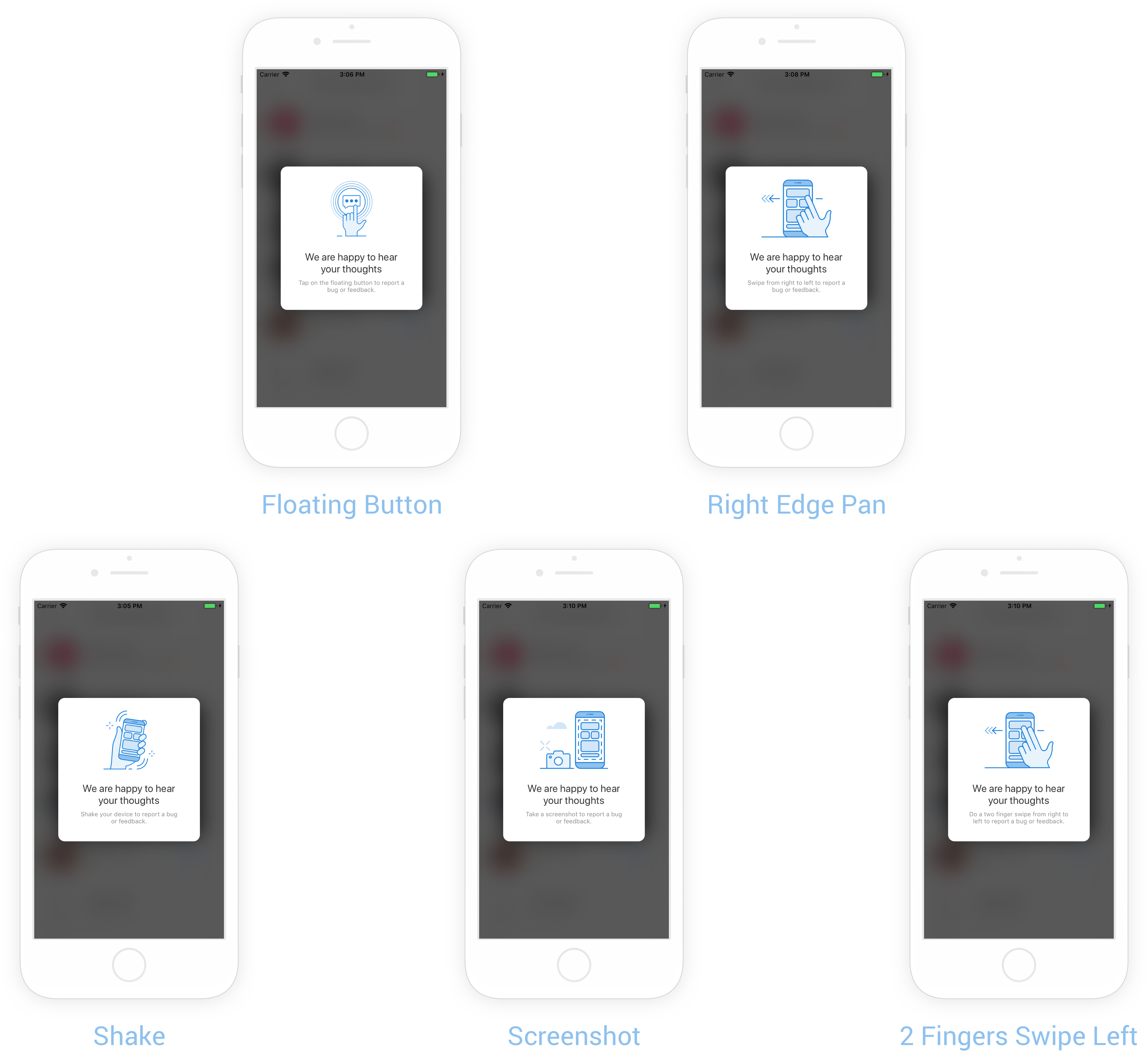
A single popup appears to your users with instructions on how to show Luciq depending on the invocation method you're using.

<figure><img src="https://828794017-files.gitbook.io/~/files/v0/b/gitbook-x-prod.appspot.com/o/spaces%2FAM8wNfllcup3GnWJ1WtW%2Fuploads%2Fgit-blob-51ab7d3c4219ff74a3256bd9805ddd123580eb74%2Fimage.png?alt=media" alt=""><figcaption><p><br><em>Examples of the welcome message that appears to users in live apps depending on the invocation method set.</em></p></figcaption></figure>

### Beta welcome message

This mode is primarily aimed at beta testers of your development builds, or beta apps.

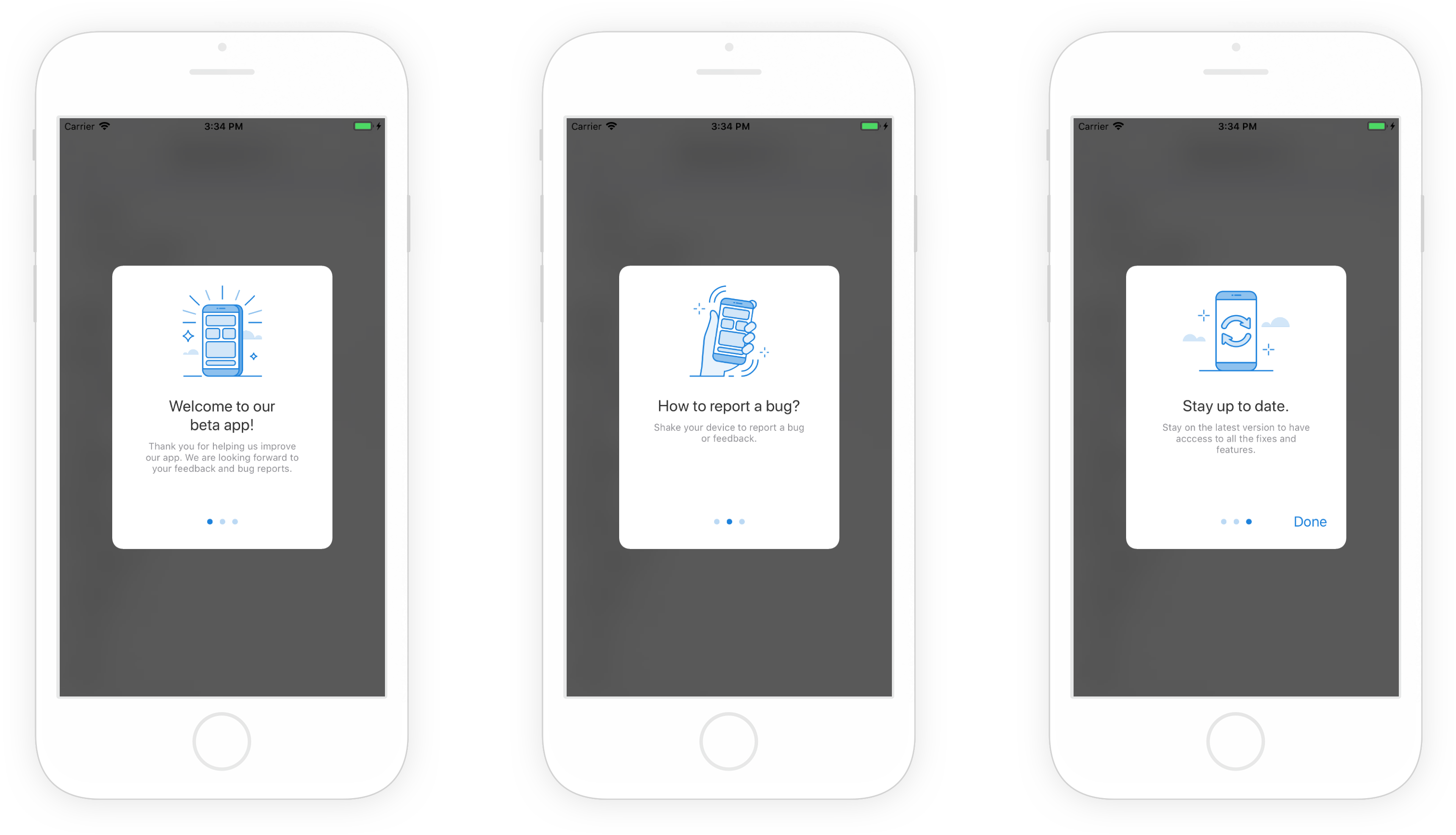
A three-step on-boarding flow appears to your testers. First, your testers see a welcome message customized for beta testers. The second screen explains how to show Luciq depending on the invocation method you're using. The third and last screen reminds your testers to use the latest version of your application in order to access all your latest fixes and features.

<figure><img src="https://828794017-files.gitbook.io/~/files/v0/b/gitbook-x-prod.appspot.com/o/spaces%2FAM8wNfllcup3GnWJ1WtW%2Fuploads%2Fgit-blob-f33dfd220531f27b4a4980858cdc5a54cdc53e03%2Fimage.png?alt=media" alt=""><figcaption><p><br><em>An example of the three-step on-boarding flow that appears to users in beta apps.</em></p></figcaption></figure>


---

# Agent Instructions
This documentation is published with GitBook. GitBook is the documentation platform designed so that both humans and AI agents can read, navigate, and reason over technical content effectively. Learn more at gitbook.com.

## Querying This Documentation
If you need additional information that is not directly available in this page, you can query the documentation by asking a question.

Perform an HTTP GET request on the following URL with the `ask` and `goal` query parameters:

```
GET https://docs.luciq.ai/ios/setup-luciq-for-ios/custom-settings/sdk-customization/welcome-message.md?ask=<question>&goal=<user_goal>
```

`ask` is the immediate question: it should be specific, self-contained, and written in natural language.
`goal` is what the user is ultimately trying to achieve, the reason they need the answer. Sharing it helps GitBook give you a better, more relevant answer. A goal is most helpful when it describes the outcome the user wants rather than restating the question. For example, with `ask=how do I create an API token`, a goal like `automate deployments from our CI pipeline` lets GitBook tailor the answer to that use case.

The response will contain a direct answer to the question and relevant excerpts and sources from the documentation.

Use this mechanism when the answer is not explicitly present in the current page, you need clarification or additional context, or you want to retrieve related documentation sections.