> For the complete documentation index, see [llms.txt](https://docs.luciq.ai/llms.txt). Markdown versions of documentation pages are available by appending `.md` to page URLs; this page is available as [Markdown](https://docs.luciq.ai/android/set-up-luciq-for-android/set-up-bug-reporting/extended-bug-report-for-android.md).
# Extended Bug Report for Android
Standardize Android bug reports with fields for steps to reproduce, actual results, and expected results. Useful for QA and technical beta testers.
### What is an Extended Bug Report?
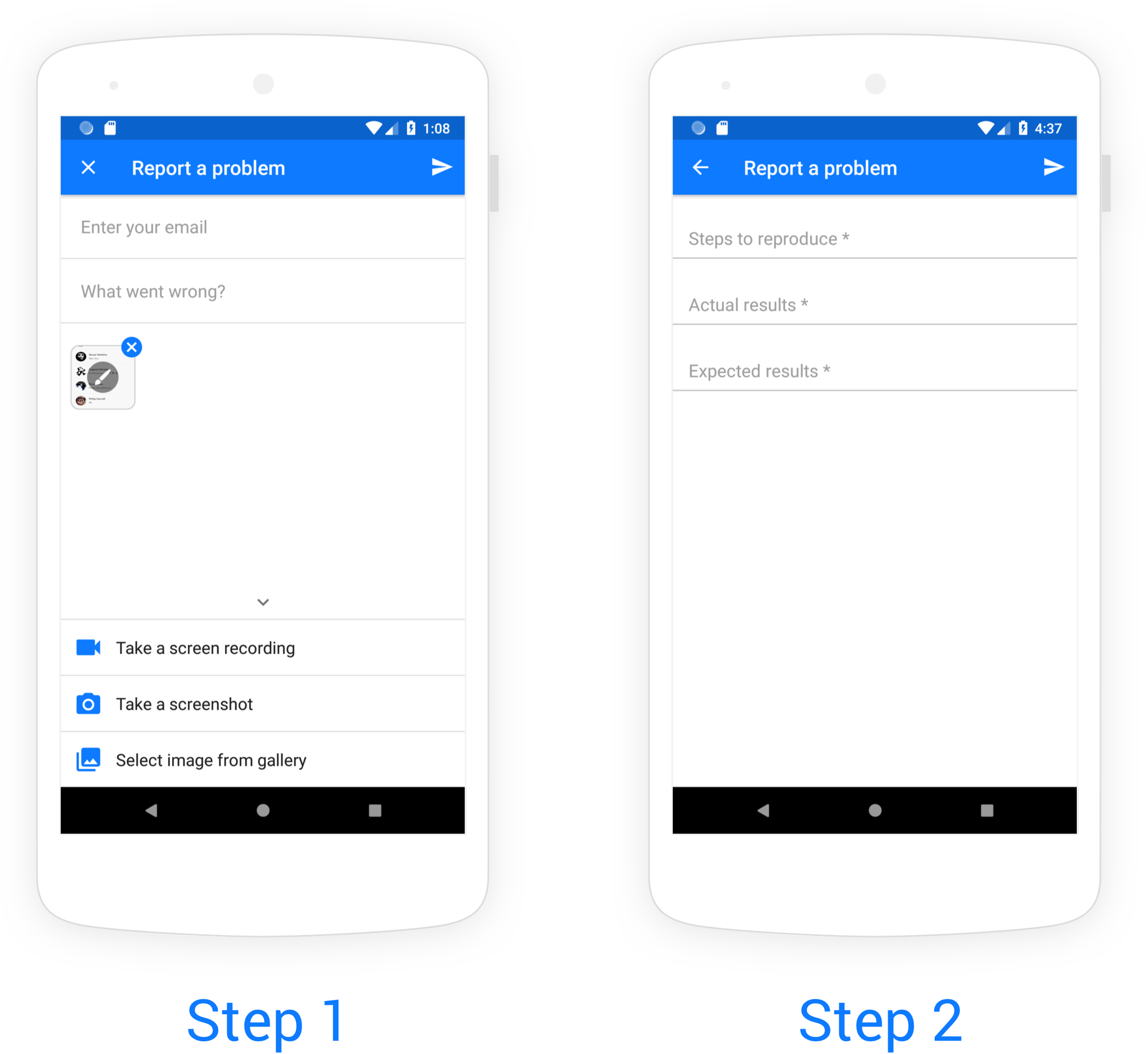
Free-form comments from reporters can be time-consuming to read through when triaging bugs. The Extended Bug Report standardizes all of your bug reports with additional fields that are commonly used by QA and technical beta testers: steps to reproduce the bug, actual results, and expected results.
If enabled, the Extended Bug Report adds a second step to the bug reporting flow that your testers experience in your app.
The Extended Bug Report includes additional fields for your testers to complete when sending reports.
### Enabling the Extended Bug Report
By default, the Extended Bug Report mode is disabled. When enabling the Extended Bug Report, you can set whether the additional fields are required or optional.
{% tabs %}
{% tab title="Kotlin" %}
{% code overflow="wrap" %}
```kotlin
BugReporting.setExtendedBugReportState(ExtendedBugReport.State.ENABLED_WITH_REQUIRED_FIELDS)
```
{% endcode %}
{% endtab %}
{% tab title="Java" %}
{% code overflow="wrap" %}
```java
BugReporting.setExtendedBugReportState(ExtendedBugReport.State.ENABLED_WITH_REQUIRED_FIELDS);
```
{% endcode %}
{% endtab %}
{% endtabs %}
Here are the possible modes you can set for Extended Bug Reports.
{% tabs %}
{% tab title="Android" %}
{% code overflow="wrap" %}
```java
//Disable extended bug report mode
ExtendedBugReport.State.DISABLED
//Enable extended bug report mode and make all additional fields required
ExtendedBugReport.State.ENABLED_WITH_REQUIRED_FIELDS
//Enable extended bug report mode and make all additional fields optional
ExtendedBugReport.State.ENABLED_WITH_OPTIONAL_FIELDS
```
{% endcode %}
{% endtab %}
{% endtabs %}
#### Override Placeholder Values
You can also override each placeholder within the Extended Bug Reports using the following method.
{% tabs %}
{% tab title="Kotlin" %}
{% code overflow="wrap" %}
```kotlin
BugReporting.setExtendedBugReportHints("Hint1", "Hint2", "Hint3")
```
{% endcode %}
{% endtab %}
{% tab title="Java" %}
{% code overflow="wrap" %}
```java
BugReporting.setExtendedBugReportHints("Hint1", "Hint2", "Hint3");
```
{% endcode %}
{% endtab %}
{% endtabs %}
{% hint style="info" %}
Passing `null` as one of the parameters will not affect in modifying the original placeholder.
{% endhint %}
---
# Agent Instructions
This documentation is published with GitBook. GitBook is the documentation platform designed so that both humans and AI agents can read, navigate, and reason over technical content effectively. Learn more at gitbook.com.
## Querying This Documentation
If you need additional information that is not directly available in this page, you can query the documentation dynamically by asking a question.
Perform an HTTP GET request on the current page URL with the `ask` query parameter, and the optional `goal` query parameter:
```
GET https://docs.luciq.ai/android/set-up-luciq-for-android/set-up-bug-reporting/extended-bug-report-for-android.md?ask=&goal=
```
`ask` is the immediate question: it should be specific, self-contained, and written in natural language.
`goal` is optional and describes the broader end goal you are ultimately trying to accomplish on behalf of the user. GitBook uses it to tailor the answer towards what is most useful for that goal.
The response will contain a direct answer to the question and relevant excerpts and sources from the documentation.
Use this mechanism when the answer is not explicitly present in the current page, you need clarification or additional context, or you want to retrieve related documentation sections.